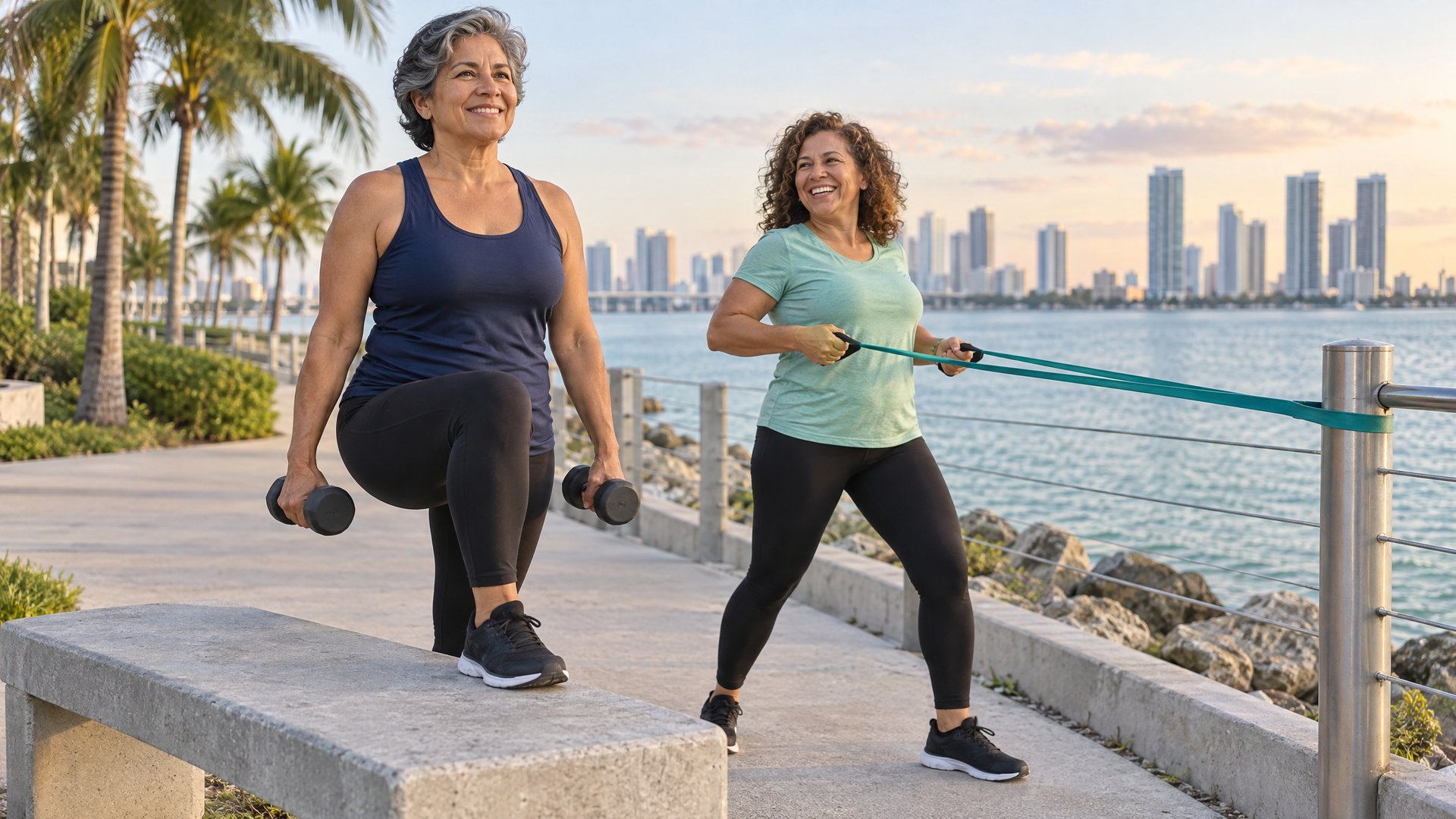
You stand up from the floor after playing with your grandkid, no hands, no wobble. You carry the patio chairs out for the family barbecue yourself. You feel solid in your body. That's the payoff of good strength training routines for women over 50, and it comes from a plan you can follow at home with a few simple tools.
Below you'll find the exact weekly routine I'd hand you on day one: three full-body sessions, clear sets and reps, joint-friendly gear and a four-week progression. Print it, save it on your phone, and start this week.
What is a good strength training routine for women over 50?
A good strength routine for women over 50 trains every major muscle group two or three times a week with full-body sessions. It includes a squat, a hip hinge, a push, a pull, a carry and core work, done for 2 to 3 sets of 10 to 12 reps. It uses joint-friendly tools and gets a little harder each week.
That structure lines up with the guidance from the National Institute on Aging. It recommends muscle-strengthening activities at least two days per week for the legs, hips, chest, back, abdomen, shoulders and arms, and notes that one set of 8 to 12 repetitions is effective while two or three sets may be more effective. The exercises should feel moderately hard, to the point where another rep would be difficult.
What makes a routine great is simple: you'll actually do it. That's why every session below fits in about 40 minutes.
How many times a week should a 50-year-old woman strength train?
Two to three times a week is the sweet spot for a 50-year-old woman. The CDC recommends at least 2 days of muscle-strengthening activity each week that work all major muscle groups. A third day speeds up progress. Leave a rest day between sessions so the same muscles aren't trained two days in a row.
The National Institute on Aging specifically advises avoiding working the same muscle group on any two days in a row to allow for recovery. A Monday, Wednesday, Friday rhythm works beautifully. On the days in between, walk, stretch or play. The CDC also recommends 150 minutes a week of moderate activity, so a 30-minute walk five days a week covers it.
What gear do you need for strength training at home?
You need far less than you think. Everything in this routine uses joint-friendly gear that fits in a closet:
- Dumbbells: a light pair and a medium pair to start. Add a heavier pair as you progress.
- Resistance bands: a loop band for glutes and a long band with handles for rows and presses.
- A sturdy chair: no wheels, placed against a wall.
- A wall: for push-ups and balance support.
- A mat: for floor work and stretching.
The National Institute on Aging suggests that beginners can try exercises without weights or bands until they're comfortable with the movements. Start there if you're new, then pick up your dumbbells in week two.
Your weekly strength training routine for women over 50
Do Day A on Monday, Day B on Wednesday and Day C on Friday. Start each session with this warm-up.
Warm-up (5 minutes, every session)
- March in place, 1 minute.
- Arm circles forward and back, 1 minute.
- Chair squats, 10 slow reps.
- Standing hip circles, 5 each direction.
- Wall slides for your shoulders, 10 reps.
Day A: legs, back and core
- Chair squat with a dumbbell: 2 to 3 sets of 10 to 12. Hold the dumbbell at your chest and tap the chair lightly with your glutes.
- Seated band row: 2 to 3 sets of 10 to 12. Sit tall on the chair, band around your feet, squeeze your shoulder blades.
- Glute bridge: 2 to 3 sets of 10 to 12. Pause for a second at the top.
- Wall push-up: 2 to 3 sets of 10 to 12.
- Dead bug: 2 sets of 8 per side, slow and controlled.
Day B: hips, shoulders and balance
- Dumbbell Romanian deadlift: 2 to 3 sets of 10 to 12. Soft knees, hips back, flat back.
- Seated dumbbell shoulder press: 2 to 3 sets of 10 to 12. Press straight up without arching your back.
- Split squat holding the chair: 2 to 3 sets of 10 per leg. Keep the range small at first.
- Band pull-apart: 2 to 3 sets of 12 to 15. Great for posture.
- Single-leg balance at the wall: 3 holds of 20 to 30 seconds per leg.
Day C: full body and carries
- Step-up onto a low, stable step: 2 to 3 sets of 10 per leg.
- One-arm dumbbell row with a hand on the chair: 2 to 3 sets of 10 to 12 per side.
- Incline push-up on a counter: 2 to 3 sets of 10 to 12.
- Side-lying leg lift or banded side step: 2 to 3 sets of 12 per side.
- Farmer's carry: 3 walks of 30 to 40 seconds with a dumbbell in each hand.
Rest 60 to 90 seconds between sets. Breathe out on the effort; the National Institute on Aging reminds you not to hold your breath during strength exercises.
Cool-down (5 minutes, every session): stretch your quads, hamstrings, hip flexors, chest and upper back for 30 seconds each.
How do you progress your routine over 4 weeks?
Progress by changing one thing at a time. The National Institute on Aging explains that gradual increases in weight, sets, reps or training days result in stronger muscles. Over four weeks, move from learning the moves to lifting with confidence. Then start the next block with heavier weights.
- Week 1: 2 sets of 10 for every exercise. Focus on form and breathing.
- Week 2: 2 sets of 12. Pick up dumbbells for any move you did with body weight.
- Week 3: 3 sets of 10. Same weights, one more set.
- Week 4: 3 sets of 12. If the last reps feel easy, it's time to move up.
In week 5, step up to the next dumbbell or a stronger band and go back to 3 sets of 10. Keep a simple log of the date, the move, the weight and your reps. Seeing those numbers grow is one of the best feelings in training.
What are the 5 exercises everyone over 50 should be doing?
If you only have time for five moves, choose a squat, a hip hinge, a row, a push-up and a loaded carry. Together they train your legs, glutes, back, chest, shoulders, grip and core. They're the same patterns you use to stand up, pick things up, push doors open and carry groceries, so the strength carries straight into your life.
- Squat (chair squat or goblet squat): stand up from any seat with ease.
- Hip hinge (Romanian deadlift): lift a box or a grandchild while protecting your back.
- Row: an upper back that keeps your posture tall.
- Push-up (wall, counter or floor): chest, shoulders and arms for pushing and reaching.
- Farmer's carry: grip strength and a braced core for carrying bags up the stairs.
The National Institute on Aging notes that muscle-strengthening activities make everyday tasks like getting up from a chair, climbing stairs and carrying groceries easier, and help prevent falls. That's exactly what these five deliver.
What is the 3-3-3 rule for strength training?
The 3-3-3 rule is a popular fitness shortcut rather than an official guideline. The most common version means 3 exercises, 3 sets each, 3 days a week. It's a handy way to keep training simple on a busy schedule, and it fits nicely inside the routine above when you're short on time.
On a tight day, pick the first three moves from that day's session and do 3 sets of each. You'll still cover a lower-body move, an upper-body move and either core or a carry. On days when you have more time, do the full session.
Why does strength training matter so much after 50?
Strength training protects your independence, your bones and your confidence. The Office on Women's Health explains that having less estrogen after menopause causes women to lose bone mass much more quickly than before, and it recommends muscle-strengthening exercises, including weight-bearing exercises, on two days each week. Lifting is one of the most practical tools you have.
The National Institute on Aging adds that strength training is key to maintaining existing strength, slowing the loss of muscle mass and helping prevent falls and fall-related injuries. In real life that means more energy, steadier balance and the feeling that your body is on your side.
How do you protect your joints while you train?
Choose variations that feel good, move through a pain-free range and build gradually. Effort in the muscle is what you want; sharp pain in a joint is your signal to adjust. Warm up every time, start lighter than you think and let the weight come later.
Here are swaps I use often:
- Knees talk to you on squats: use a higher chair and a shorter range.
- Split squats feel shaky: hold the chair with both hands, or swap in step-ups on a lower step.
- Shoulders feel tight overhead: press at a slight angle forward, or do band pull-aparts instead.
- Wrists complain on push-ups: do them against the wall, or hold dumbbell handles on the counter.
If you have osteoporosis, a joint replacement, a recent injury or a heart condition, talk with your doctor or physical therapist before starting. With their guidance, a well-built routine helps you train with confidence.
Training in Doral: early mornings and good company
Here in Miami, the heat and humidity shape when and how we train. If you like working out on a patio or in a park, go early, before 8 a.m., and keep water close. On the hottest days, move your session indoors where it's cool. And find your people: training alongside other women your age makes it so much easier to show up three times a week. That sense of community is a big part of the Limitless40 program, where more than 22 women have already transformed and more than 5 bootcamps have been completed.
Get your strength training routine for women over 50 started with Andre
You have everything you need to start this week. If you want a coach in your corner, leave your details here and chat with me on WhatsApp. Tell me your goal and the gear you have, and I'll share a starter plan built for your body. You can read more about me and my 3 Pillars Method, and if you're in your 40s, my guide to strength training for women over 40 covers the same foundations.