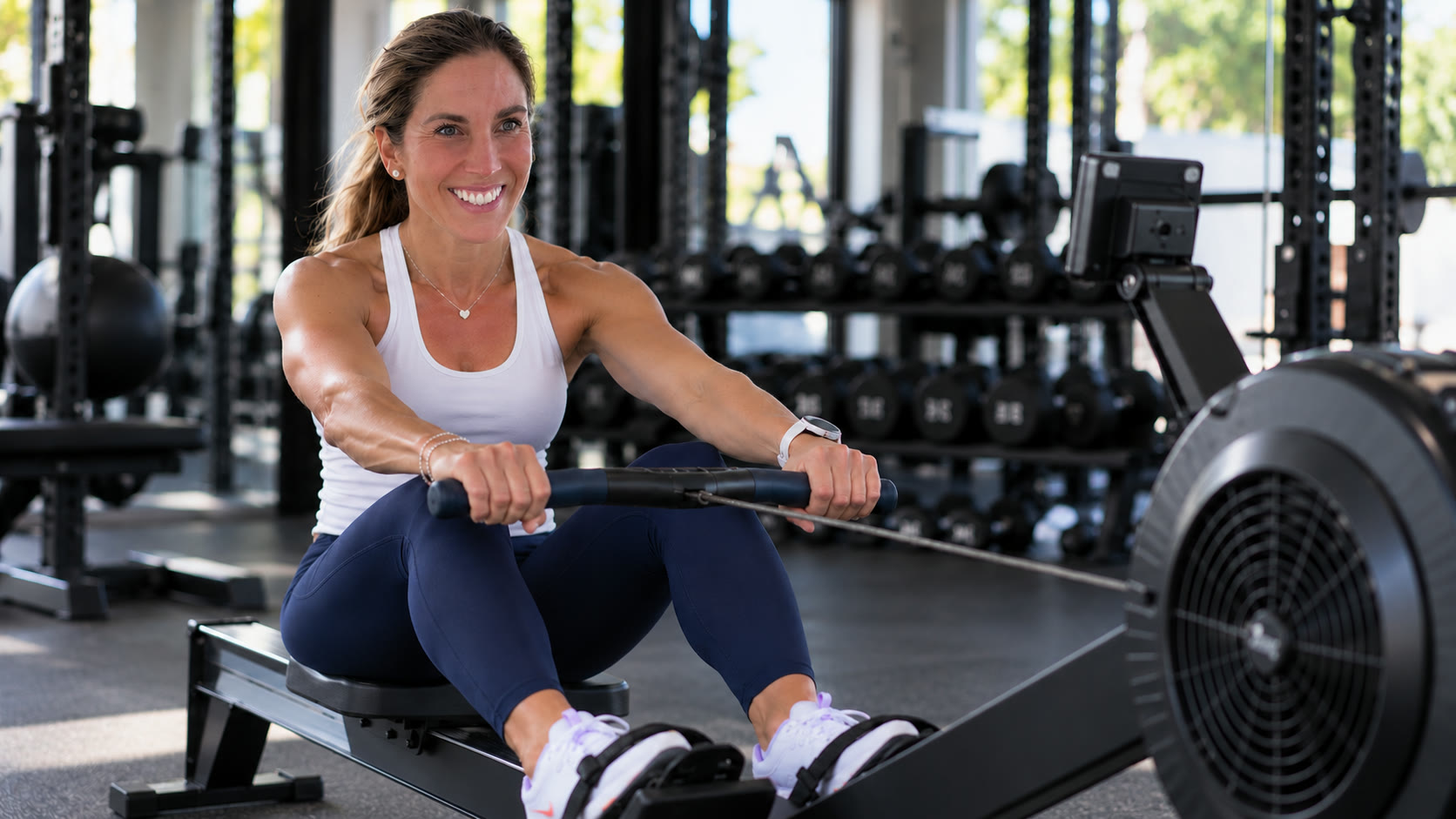
Picture yourself at the start line. Music pumping, your heart beating fast, a friend next to you grinning. Eight weeks ago you didn't know what a sled pull felt like. Today your legs are strong, your grip is solid, and you know exactly how you'll pace that first kilometer. That's what a good HYROX training plan for beginners gives you: a clear path, week by week, to a race day you'll remember with pride.
This plan is built for women over 40. It uses three or four sessions a week, protects your recovery, and teaches every station with scaling options so you build up at the right speed for your body. If you're training here in South Florida, read my guide to HYROX training in Miami too, because heat and humidity change how you plan your week.
How should I structure my HYROX training?
Structure your HYROX training around three building blocks: running, strength, and "combo" sessions that link a run to a station. The race is 8 rounds of a 1 km run plus one workout station, so you need a running base, strong legs and grip, and practice running on tired legs. Rest days complete the structure.
Here's how the week works in this plan:
- Session A, strength: squats, lunges, step ups, rows, presses and carries. This builds the muscles that power the sled, lunges and wall balls.
- Session B, easy run: a conversational pace, the kind where you could chat with a friend. This builds your engine.
- Session C, combo: short runs paired with station work, so your body learns to switch gears.
- Session D, optional: a longer easy run, a padel match, or a brisk walk. Do it only if you feel recovered.
Keep at least one day between Session A and Session C. Your glutes, quads and back do a lot of work in both.
What weights do women use in HYROX?
In the Women Open division, the official HYROX rulebook (season 26/27) lists a sled push of 102 kg including the sled, a sled pull of 78 kg including the sled, two 16 kg kettlebells for the farmers carry, a 10 kg sandbag for lunges, and a 4 kg wall ball thrown to a 2.70 m target. The Pro division uses heavier weights.
Here's the full Women Open race, station by station, with each one coming after a 1 km run:
- SkiErg: 1,000 meters.
- Sled push: 50 meters total (the rulebook splits it into 4 lengths of 12.5 m), 102 kg including the sled.
- Sled pull: 50 meters total, 78 kg including the sled.
- Burpee broad jumps: 80 meters.
- Rowing: 1,000 meters.
- Farmers carry: 200 meters with 2 x 16 kg kettlebells.
- Sandbag lunges: 100 meters with a 10 kg sandbag.
- Wall balls: 100 reps with a 4 kg ball to a 2.70 m target.
Remember that a sled's feel depends on the floor, so the same weight can feel different from gym to gym. Always check the current rulebook on hyrox.com before race day in case standards are updated.
What's a good gym routine for a beginner?
A good beginner gym routine covers the big movement patterns two or three times a week: a squat, a hinge, a lunge, a push, a pull and a carry. For HYROX, add rowing or ski intervals and some wall ball practice. Start lighter than you think, master the technique, and add weight or reps a little each week.
This is the strength session (Session A) you'll use throughout the plan. Do 2 to 3 sets of each:
- Goblet squat: 10 to 12 reps. Quads and glutes for wall balls and sled push.
- Romanian deadlift with dumbbells: 10 to 12 reps. Hamstrings and glutes for the sled pull.
- Reverse lunge: 8 to 10 reps per leg. Prepares you for the 100 meter lunge.
- Dumbbell row: 10 to 12 reps per arm. Back strength for the sled pull and SkiErg.
- Push up (on a bench or wall if needed): 8 to 12 reps. Upper body for burpees.
- Farmers carry: 3 walks of 30 to 40 meters with moderate kettlebells. Grip, traps and core.
- Dead bug or plank: 30 seconds. A strong core protects your low back on every station.
The last two reps of each set should feel challenging but clean. That's the sweet spot for building strength after 40.
Your 8-week HYROX training plan for beginners
This plan assumes you can jog or walk-run for about 20 minutes and have done some strength training. Each week lists three core sessions plus an optional fourth. Weeks 4 and 8 are lighter on purpose: Week 4 lets your body absorb the work, and Week 8 brings you to race day fresh.
Week 1: learn the movements
- A: strength session, 2 sets each, light weights.
- B: easy run or walk-run, 20 to 25 minutes.
- C: 4 rounds of 400 m easy run plus 10 wall balls (light ball, lower target if needed).
- D (optional): 30 minute brisk walk.
Week 2: build the base
- A: strength session, 2 to 3 sets.
- B: easy run, 25 minutes.
- C: 4 rounds of 500 m run plus 250 m row or 20 walking lunges.
- D (optional): easy run or padel.
Week 3: add station time
- A: strength session, 3 sets, slightly heavier.
- B: easy run, 30 minutes.
- C: 4 rounds of 500 m run plus one station: farmers carry 100 m, 15 wall balls, 250 m SkiErg or row, 10 burpee broad jumps.
- D (optional): easy run, 25 minutes.
Week 4: lighter week
- A: strength session, 2 sets, same weights as Week 3.
- B: easy run, 20 to 25 minutes.
- C: 3 rounds of 500 m run plus 10 wall balls and 20 lunges, relaxed pace.
- D: rest, stretch, or a gentle walk.
Week 5: longer efforts
- A: strength session, 3 sets, add a sled push or heavy push of a loaded object if available.
- B: easy run, 30 to 35 minutes.
- C: 4 rounds of 1 km run plus one station: 500 m row, 20 wall balls, 40 m sled push or pull (scaled), 100 m farmers carry.
- D (optional): long easy walk or padel.
Week 6: race rhythm
- A: strength session, 3 sets.
- B: easy run, 35 minutes, or 5 x 3 minutes slightly faster with 2 minutes easy between.
- C: half simulation: 4 rounds of 1 km run plus stations 1 to 4 (scaled SkiErg, sled push, sled pull, burpee broad jumps).
- D (optional): easy run, 30 minutes.
Week 7: race simulation
- A: strength session, 2 to 3 sets, touch race weights on carries and lunges if you feel good.
- B: easy run, 30 minutes.
- C: half simulation: 4 rounds of 1 km run plus stations 5 to 8 (row, farmers carry, sandbag lunges, wall balls), scaled as needed.
- D: rest.
Week 8: taper and race
- A: short strength session early in the week, 2 sets, light.
- B: easy run, 20 minutes, with 4 short strides.
- C: 3 rounds of 500 m run plus 10 wall balls, just to stay sharp.
- Race day: start your first kilometer slower than you think, and enjoy every station.
Scaling options for every station
Scaling means adjusting weight, distance or movement so you train the pattern safely while you build strength. It's how smart athletes of every age train. For women over 40, scaling protects your joints and keeps you progressing week after week instead of stalling with soreness. Use these until the race-weight version feels within reach.
- SkiErg: no machine? Do standing band pull-downs, 3 sets of 15.
- Sled push: push a loaded sled lighter, or do incline treadmill walks with hands on the rail, or heavy step ups.
- Sled pull: use a lighter sled, or do seated band rows and heavy dumbbell rows.
- Burpee broad jumps: step back instead of jumping back, and take a smaller jump forward.
- Rowing: shorter intervals (250 m) with rest, building toward 1,000 m.
- Farmers carry: lighter kettlebells or dumbbells, shorter walks, then build distance.
- Sandbag lunges: bodyweight lunges first, then hold light dumbbells, then the sandbag.
- Wall balls: a lighter ball, a lower target, or squat to a box and press the ball overhead.
Recovery: the secret weapon after 40
Recovery is where your body turns training into strength. After 40, sleep, protein, hydration and rest days have an even bigger effect on how fast you progress and how good you feel. A beginner plan with built-in lighter weeks lets you arrive at race day energized and healthy, not tired and sore.
My recovery basics for every woman I coach:
- Sleep 7 or more hours on most nights. Your muscles rebuild while you sleep.
- Eat protein at every meal: huevos pericos at breakfast, chicken or fish at lunch, black beans and queso blanco at dinner.
- Hydrate all day, especially on training days in South Florida heat.
- Keep at least one full rest day every week.
- Listen to joint pain. Muscle burn is normal; sharp pain in a knee, hip or back means stop and adjust. If you have an injury or medical condition, check with your doctor before starting.
The CDC recommends that adults get at least 150 minutes of moderate activity a week plus at least 2 days of muscle-strengthening activity. This plan covers both, with a clear goal at the end.
8-week vs 12-week HYROX plan: which one fits you?
Choose 8 weeks if you already exercise regularly and can jog for 20 minutes or more. Choose 12 weeks if you're new to running, coming back after a long break, or managing an old injury. The extra time is for building your running base and strength slowly, so the 8-week block above feels comfortable when you start it.
A simple way to turn this into a 12-week plan: repeat Weeks 1 to 3 once at an easier level before starting Week 1 for real, and add one more easy week after Week 5.
Train for your first HYROX with Andre
I'm Andre, an ISSA-certified personal trainer and nutrition coach, Venezuelan mom of three, coaching women in Miami since 2018 from my home studio in Doral. In Limitless40, HYROX, padel and running are part of our training pillar, and you can read more about me here.
The Método 3 Pilares joins training, nutrition, and mindset and faith, so you fuel your body and keep your mind steady through every week of the plan. More than 22 women have transformed with Limitless40, and we've completed over 5 bootcamps together.
Get your HYROX training plan for beginners from Andre
You're ready to cross that finish line feeling strong and proud. Tell Andre your race date and where you're starting from. Leave your details here and you'll go straight to a WhatsApp chat with her. She'll share a plan adjusted to your level and schedule, and show you how the Limitless40 program can train you alongside a community of strong women.