It's 6:15 a.m. in Doral and the air already feels warm. You want to get stronger, you want more energy for your kids and your work, and you want someone in your corner who understands a woman's body after 40. That's why you're looking for a female personal trainer in Doral or Miami, and it's a smart move.
A good coach turns "I should work out" into a plan you actually enjoy. This guide walks you through what certifications mean, the questions worth asking, how in-person, online and small group training compare, the red flags to skip, and what a great first session looks like. By the end, you'll know exactly what to look for.
What should a woman over 40 look for in a personal trainer?
Look for three things: a recognized certification, real experience coaching women over 40, and a coach who listens before she programs. The right trainer asks about your health history, your schedule, your goals and what you love to do, then builds strength training around your life. You should leave the first conversation feeling understood and excited, never judged or rushed.
Here's what that looks like in practice:
- She asks before she prescribes. Old injuries, energy levels, sleep, stress, how many days you can realistically train.
- She talks about strength, not punishment. Stronger glutes, a steadier core, shoulders that carry grocery bags with ease.
- She coaches technique. You should understand why your knees track over your toes and how to brace your core.
- She plans progression. Every few weeks the plan should move forward: more reps, a heavier dumbbell, a new movement.
- She thinks beyond the workout. Nutrition, recovery and mindset all affect how you feel and how fast you build strength.
Choosing a woman as your coach is a personal preference, and a valid one. Many women feel more relaxed talking about hormones, pelvic floor changes or body confidence with another woman who has lived some of it herself.
What do personal trainer certifications like ISSA, NASM and ACE mean?
A certification shows a trainer studied exercise science, program design and safety, then passed an exam. ISSA (International Sports Sciences Association), NASM (National Academy of Sports Medicine) and ACE (American Council on Exercise) are three of the most common in the US. Many employers look for exams accredited by the NCCA, an independent body that reviews certification programs.
A few quick facts so you can read a trainer's bio with confidence:
- ISSA offers personal training and nutrition coaching courses. Its NCCA-accredited personal trainer exam is delivered through the NCCPT, an ISSA company, as a proctored, closed-book test.
- NASM offers the NASM-CPT, a proctored exam that NASM lists as NCCA-accredited.
- ACE offers a personal trainer certification with an NCCA-accredited exam option.
- The NCCA (National Commission for Certifying Agencies) accredits certification programs that meet its standards for testing competence and protecting the public.
A certificate is the floor, not the ceiling. Ask when she certified, whether she keeps it current with continuing education, and whether she holds a nutrition credential if she'll guide your eating. Then look at her experience: how long she has coached, and how many women in your stage of life she has trained.
What questions should I ask a personal trainer before hiring her?
Ask questions that show you how she thinks, not just what she charges. A great trainer will answer clearly and ask you just as many questions back. Bring this list to your first call or consultation and notice how you feel during the conversation, because the right coach makes you feel capable from minute one.
- What certifications do you hold, and when did you earn them?
- How much experience do you have coaching women over 40?
- What does a typical first month look like with you?
- How do you adjust training for knees, backs or shoulders that need extra care?
- How will we measure progress besides the scale?
- Do you offer in-person, online or small group options?
- How do we communicate between sessions?
- What happens if I travel or miss a week?
- Do you guide nutrition, and what credential supports that?
Listen for specifics. "We'll start with a movement assessment, then two full-body strength days a week" tells you far more than "We'll get you in shape."
Should I train in person, online or in a small group?
Each format works; the best one is the one you'll keep doing. In-person training gives you hands-on feedback on technique. Online coaching fits around school runs, work and travel. Small group training adds energy, friendship and accountability. Many women over 40 start in person to learn the movements safely, then mix in online sessions or a group as their confidence grows.
Here's a simple comparison:
- In person, one-on-one: Full attention, real-time form corrections, a plan built around your body. Best for beginners or anyone coming back from a break.
- Online coaching: A structured plan, video check-ins and messaging. Great if your schedule changes week to week or you prefer training at home.
- Small group or bootcamp: Shared energy, friendly competition and a community that notices when you don't show up.
- Hybrid: A few in-person sessions to nail technique, then online programming with periodic check-ins.
Here in South Florida, timing matters too. Summer heat and afternoon storms make early mornings and indoor or shaded sessions the sweet spot. A coach who knows Doral understands that a 7 a.m. session before school pickup is very different from a 2 p.m. one in August.
How much does a personal trainer cost in Miami?
Prices vary widely across Miami, and there's no reliable public source for current local averages, so take any number you see online with a grain of salt. What changes the cost is the format, session length, the trainer's experience and what's included. One-on-one sessions usually cost the most per hour; small groups and online coaching cost less per session.
When you compare options, look at what you're actually getting:
- Format: private, semi-private, small group or online.
- Session length and frequency: 30, 45 or 60 minutes, and how many times a week.
- Location: a commercial gym, a private studio, your home or a park.
- What's included: a written plan, nutrition guidance, check-ins between sessions, an app.
- Commitment: single sessions, packages or a structured multi-week program.
Ask every trainer to explain her options in plain language. Andre doesn't publish prices on the site; she walks you through what fits your goals and schedule when you chat on WhatsApp.
Is it worth paying for a personal trainer after 40?
For many women, yes. A coach teaches safe technique, adjusts each movement to your body and keeps you consistent, and consistency is where the results live. The CDC recommends muscle-strengthening activity at least 2 days a week for adults, and having someone expecting you makes those two days far more likely to happen.
The value also shows up in ways a spreadsheet can't measure: lifting your carry-on into the overhead bin without asking for help, keeping up with your teenager on a walk, walking into a padel match feeling strong instead of stiff. That confidence spills into everything else.
And short sessions count. A focused 30-minute strength workout, done two or three times a week with steady progression, builds real strength. You don't need to live at the gym.
What are the red flags when choosing a personal trainer?
The biggest red flag is a trainer who talks more than she listens. Others: no current certification, a one-size-fits-all plan, pushing through pain, and promises of fast weight loss or dramatic before-and-after results. A good coach for women over 40 is patient, specific and respectful of your body, and she knows when to refer you to a doctor.
Skip anyone who:
- Can't tell you which certification she holds or when she earned it.
- Gives you the same workout she gives everyone else.
- Tells you pain means progress.
- Sells supplements as the main solution.
- Promises a number on the scale by a certain date.
- Uses shame about age or weight to "motivate" you.
What you want instead is a coach who celebrates your strength, explains the why behind each exercise and changes the plan when your body asks for it.
What happens in a first personal training session?
A strong first session is mostly about getting to know you. Expect a conversation about your health, goals and routine, a simple movement check (a squat to a chair, a wall push-up, a few steps of balance), then a short, doable workout. You should leave a little energized, clear on the next step and proud of what you did.
A typical first session flows like this:
- Conversation (10 to 15 minutes): health history, past injuries, goals, schedule, what you enjoy.
- Movement check (10 minutes): how you squat, hinge, push, pull and balance.
- Short workout (15 to 20 minutes): a few foundational moves at an easy, confident level.
- Plan and next steps (5 minutes): how many days a week, what to do at home, how you'll stay in touch.
If you have a medical condition, ongoing pain or a recent surgery, check with your doctor before you start and bring their guidance to the session.
Where can I find a female personal trainer near Doral?
Start close to home, because a short drive makes it easier to show up. Doral sits in the middle of Miami-Dade, so women from nearby neighborhoods like Kendall, Weston, Miami Lakes, Hialeah and Coral Gables can reach a Doral studio fairly easily, depending on traffic. Ask about early morning slots, and whether online sessions can fill in on busy weeks.
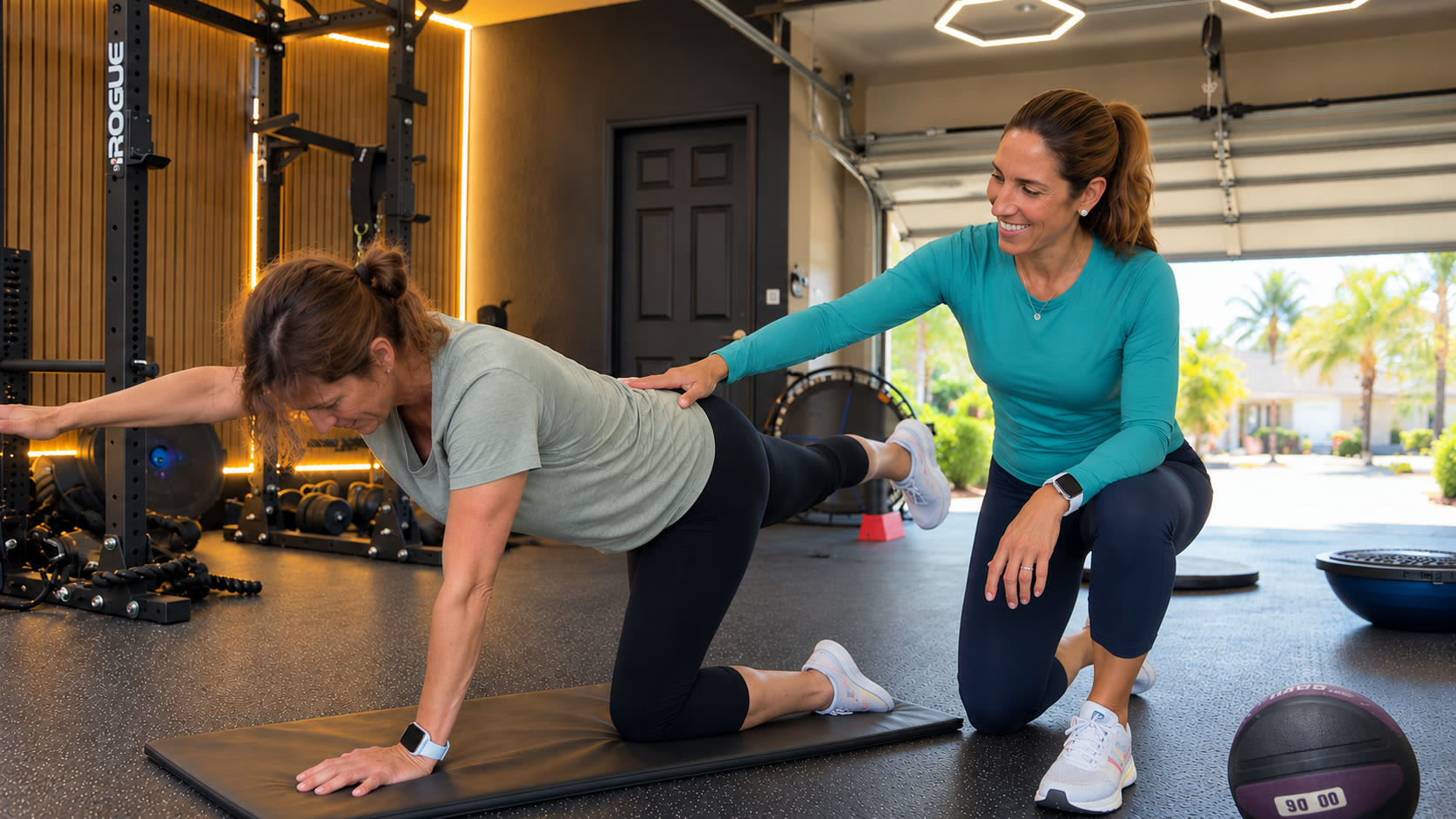
One option is Andreina Carvallo (Andre). She's an ISSA-certified personal trainer and nutrition coach, a Venezuelan mom of three, bilingual in English and Spanish, and she has lived in Miami since 2018. She trains women from her home studio in Doral (33166) and leads Limitless40, a 90-day program for women over 40 built on three pillars: training, nutrition, and mindset and faith. More than 22 women have transformed with her, and she has completed more than 5 bootcamps.
You can read her story on the About Andre page, see how the 3 Pillars Method works, or explore the Limitless40 programs. If you prefer Spanish, her guide to building muscle after 40 is a great place to start.
Talk to a Female Personal Trainer in Doral Today
You already know you want to feel stronger. The next step is a simple conversation. Leave your details here, then chat with Andre on WhatsApp: tell her your goal, your schedule and how you like to train, and she'll walk you through the option that fits you best, in English or Spanish.