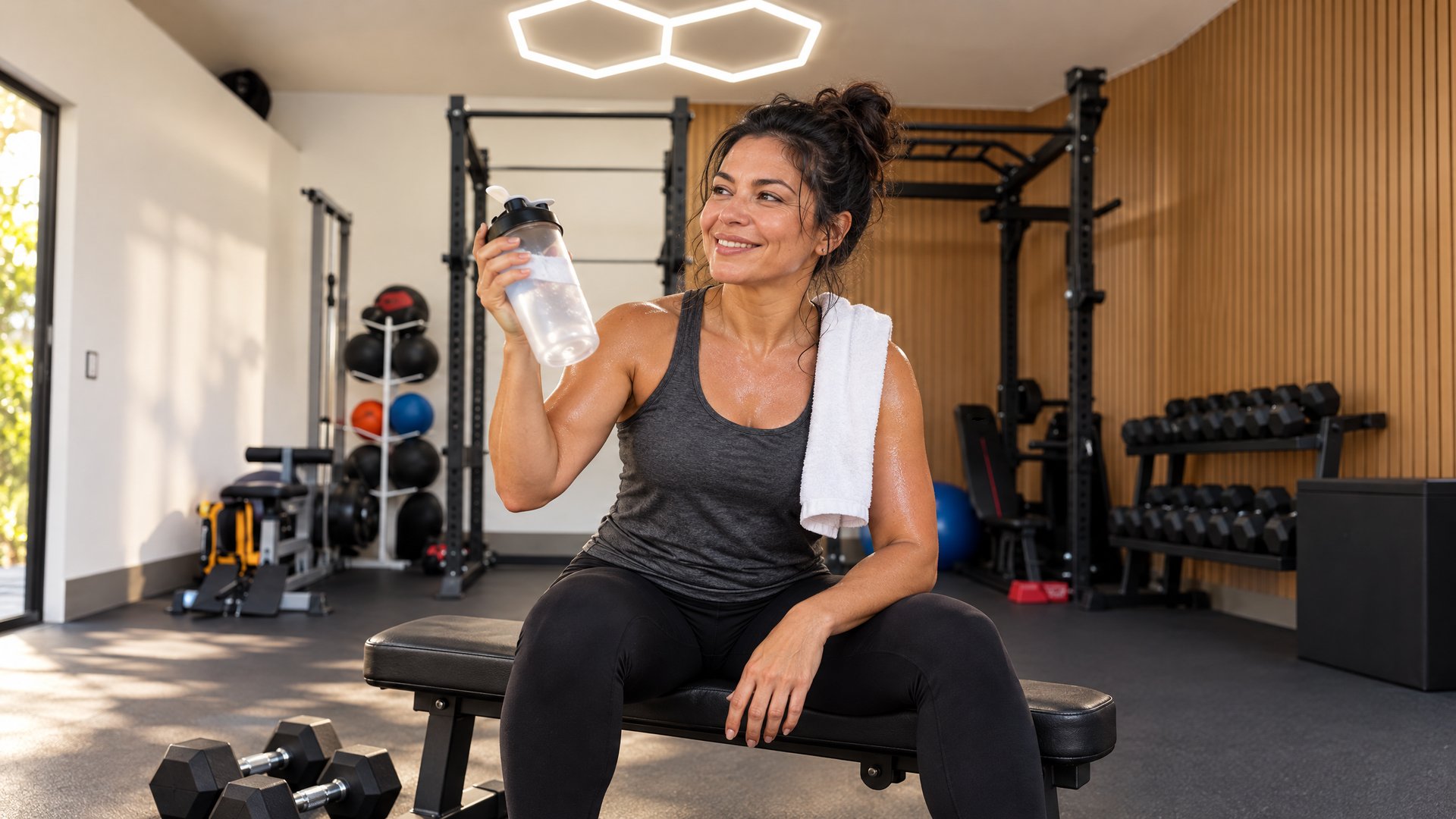
You finish your last set of goblet squats, set the dumbbell down, and feel it: your quads are burning, your glutes are awake, and you're proud. Then a friend at padel asks, "Are you taking creatine yet?" Suddenly everyone in your group chat has an opinion. So let's talk about creatine for women over 40, calmly and with real research, so you can walk into your next doctor's appointment informed and confident.
Here's my promise for this article. You'll learn what creatine is, what studies in women over 40 actually found, what researchers commonly used, which side effects are real, and how creatine fits next to the thing that matters most: your strength training. I'm a coach, not a doctor, so this is education, not a prescription.
What is creatine, and why are women over 40 talking about it?
Creatine is a compound your body makes and stores mostly in your muscles, where it helps recycle the quick energy you use for short, hard efforts like a heavy squat or a sprint up the stairs. You also get some from meat and fish. As a supplement, it's one of the most researched in sports nutrition, and studies in women, especially after menopause, have grown a lot.
Why the buzz now? Because women over 40 are lifting more than ever, and that's beautiful to see. After 40, keeping and building muscle becomes one of the best things you can do for energy, posture, balance and confidence. Creatine has been studied as a way to support that work, which is why it keeps showing up in your feed.
A 2021 review in the journal Nutrients, written by researchers who study women specifically, made an important point: women have been understudied in creatine research. That's changing, and the newer studies are the ones I'll walk you through.
Should I take creatine if I'm over 40?
That decision belongs to you and your doctor, but the research gives you a solid starting point. The International Society of Sports Nutrition reviewed the evidence and found no compelling evidence of harm from creatine monohydrate in healthy people. In women after menopause, the clearest benefits showed up when creatine was paired with regular strength training.
So the honest answer is this: creatine is a helper, and strength training is the engine. If you're already training two or three days a week, or you're ready to start, creatine is a reasonable topic to raise with your doctor. If you have kidney disease, take medications that affect your kidneys, or have another medical condition, that conversation is a must before you buy anything.
Questions worth bringing to your appointment:
- Is creatine appropriate for my health history and current medications?
- Do my kidney numbers from recent lab work raise any concerns?
- If I try it, how should we check in on how I'm feeling?
- Should I see a registered dietitian for my overall nutrition plan?
What are the potential benefits of creatine, according to research?
Research in women over 40 points to three areas: muscle and strength, bone structure, and the brain. The strongest signal is for muscle and physical performance when creatine is combined with resistance training. Bone results are mixed, and brain research is early but interesting. Here's what the studies found, without the hype.
- Muscle and strength. The 2021 Nutrients review reported that in postmenopausal women, creatine combined with resistance training more consistently improved muscle, strength and physical performance than training alone, while low doses taken without training showed little effect. Some trials found no added benefit, so results vary.
- Bone. A 2-year randomized trial of 237 postmenopausal women (average age 59) who did resistance training and walking found that creatine did not change bone mineral density compared with placebo. It did preserve some measures of bone shape and strength at the hip, though the authors noted those changes were small.
- Walking speed and lean tissue. In that same trial, the creatine group improved their 80 meter walking time more than the placebo group. Lean tissue gains were higher with creatine only in the participants who completed the study as planned.
- Brain and mood. The ISSN position stand cites studies where creatine reduced mental fatigue and improved some memory and processing tasks. The Nutrients review describes early evidence on mood and cognition in women, though much of it comes from small studies.
Notice the pattern? Every meaningful result came alongside training. That's why I'll always tell you to build the habit of lifting first. If you're new to it, start with my guide to strength training for women over 40.
Creatine for menopause and perimenopause: what do we know?
Most of the creatine research in midlife women was done after menopause, so we know more about that stage than about perimenopause. In postmenopausal women, creatine with strength training shows the most promise for muscle and performance. Research specific to perimenopause is still thin, which means any claims you see online are ahead of the science.
During the menopause transition, many women notice changes in energy, sleep, muscle tone and focus. It's natural to look for tools that help you feel like yourself again, strong and clear headed. The researchers behind the 2021 review are enthusiastic about creatine's potential across a woman's life, and they're also clear that larger and longer trials are needed.
Two things to keep in mind when you read about creatine for menopause:
- Look at who was studied. A trial in 60 year old women who trained three days a week tells you something different than a trial in young athletes.
- Notice disclosures. The 2021 review discloses that two authors advise a creatine manufacturer, which is common in this field and worth knowing when you weigh the conclusions.
Hormone questions, hot flashes and sleep changes deserve a conversation with your doctor. Creatine isn't a treatment for menopause symptoms. It's a supplement that may support the strength work you're doing.
How much creatine should a woman over 40 take?
The right amount for you is a question for your doctor or a registered dietitian. What I can share is what studies commonly used. The ISSN describes two approaches: a short loading phase followed by a smaller daily amount, or a smaller daily amount from the start, which raises muscle stores more gradually over about 3 to 4 weeks.
Here's what the research protocols looked like, so the numbers in your doctor's office make sense:
- ISSN loading approach: about 0.3 grams per kilogram of body weight per day for 5 to 7 days, followed by 3 to 5 grams per day.
- ISSN gradual approach: smaller daily amounts (3 to 5 grams per day) that raise stores over roughly 3 to 4 weeks.
- The 2-year postmenopausal trial: about 0.14 grams per kilogram of body weight per day, taken along with a resistance training and walking program.
Those are research protocols, not a plan for you. Your body weight, your kidneys, your medications and your goals all matter. Bring this list to your appointment, and decide together.
Does creatine have side effects for women?
The most consistent side effect reported in the research is a small increase in body weight, mostly from extra water stored in the muscles. The ISSN describes short term fluid retention of about half a liter to one liter. In the 2-year postmenopausal trial, kidney, liver and digestive side effects were reported at similar rates in the creatine and placebo groups.
What that means in real life:
- The scale may move up a little at first. That's water in your muscles, not fat. Judge your progress by how strong you feel and how your clothes fit.
- Muscle cramps. In the 2-year trial, two women in each group reported cramps, so cramps weren't more common with creatine. Still, stay well hydrated, especially here in South Florida.
- Kidney health. The ISSN found no compelling evidence that creatine harms kidney function in healthy people, and it notes that anyone with existing kidney disease should talk to a physician first.
If anything feels off, stop and call your doctor. Your body gives you good information when you listen.
What happens when you stop taking creatine?
When you stop, the extra creatine stored in your muscles slowly returns to your usual level. The ISSN position stand says this generally takes 4 to 6 weeks. Your body keeps making its own creatine, and the strength you built through training doesn't disappear overnight. Keep lifting and you keep your muscle.
This is the part I love sharing with my clients. The real asset is the muscle you earn with your squats, rows and deadlifts, plus the protein on your plate and the sleep you protect. Creatine may help you squeeze a little more out of each session. Your consistency is what builds the strong, capable body you feel every day.
How creatine fits into a strong week
Creatine only matters if the training and nutrition are in place. In Limitless40, the Método 3 Pilares puts training, nutrition, and mindset and faith side by side, because each one holds up the others. Here's what a simple, strong week can look like:
- Monday: lower body strength (squats, glute bridges, step ups), 35 to 45 minutes.
- Tuesday: brisk walk or easy run, 30 minutes.
- Wednesday: upper body and back (rows, presses, carries), 35 to 45 minutes.
- Thursday: mobility and a short core session.
- Friday: full body strength, 35 to 45 minutes.
- Weekend: padel with friends, a long walk, or a family day at the park.
And on your plate, protein at every meal, the way you already know how to cook:
- Breakfast: huevos pericos with a small arepa and avocado.
- Lunch: grilled chicken or fish, rice or plantain, a big salad.
- Snack: Greek yogurt with fruit or a handful of nuts.
- Dinner: black beans with queso blanco and sautéed vegetables.
Training in Miami heat: hydration first
If you train in Doral or anywhere in Miami, hydration isn't optional. The heat and humidity here mean you sweat more than you think, even at 7 a.m. Since creatine pulls water into your muscles, it's one more reason to keep a water bottle with you all day, not just during your workout.
My simple rules for my Doral clients: drink water before you feel thirsty, train early or in an air conditioned space during summer, and add a pinch of salt or an electrolyte drink on long sweaty days if your doctor is fine with it. I've coached women in Miami since 2018, and the ones who feel best are the ones who treat water like part of the workout.
Who's guiding you matters
There's a lot of noise about supplements, much of it written by companies that sell them. I'm an ISSA-certified personal trainer and nutrition coach, and I don't sell creatine or any supplement. My job is to help you train with good technique, eat in a way that fuels your muscles, and stay consistent long enough to feel the change. You can read more about me and how I coach.
Over 22 women have transformed with Limitless40, and we've completed more than 5 bootcamps together. Each of them started with strength, food and a decision to show up for herself.
Pair creatine for women over 40 with a real plan: talk to Andre
You're ready to feel stronger, more energized and unstoppable. Tell Andre your goal. Leave your details here, and you'll go straight to a WhatsApp chat with her. She'll listen, answer your questions about training and nutrition, and share a plan that fits your week. Take a look at the Limitless40 program, and for any supplement decision, talk to your doctor first.